
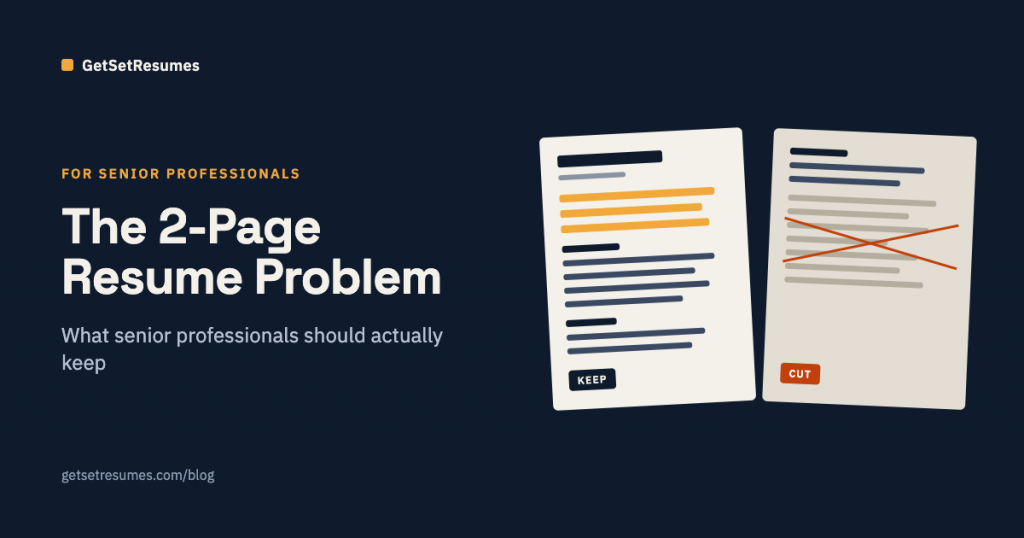
A senior professional opens their resume and sees twenty years of experience staring back at them. Five companies. Seven designations. Dozens of projects. Multiple industries. Major clients. Team sizes. Awards. Certifications. Revenue numbers. Transformation initiatives. International exposure. Leadership responsibilities spanning more than a decade.
Then someone tells them to keep it to two pages.
That’s usually where the trouble starts. The instinct is to squeeze everything in. Smaller fonts, tighter margins, more bullets, longer sentences, and somehow every achievement from the last decade survives the editing process anyway. What comes out the other end is technically a two-page resume, but it isn’t necessarily a better one.
For a senior professional, the real challenge was never figuring out how to fit fifteen or twenty years of experience onto two pages. It’s deciding which parts of that experience actually deserve the limited attention a recruiter or hiring manager has to give. A senior resume shouldn’t function as an archive of everything a professional has ever accomplished. It should function as a strategic document that makes someone’s current leadership value immediately obvious.
Is two pages really the rule?
Not exactly. For plenty of professionals, two pages give enough room to cover experience, achievements, skills, and career progression without running long. But senior leadership resumes sometimes genuinely need more space, especially for candidates with extensive leadership history, international exposure, a complex career path, board-level responsibilities, or highly specialized expertise.
The mistake is treating page count as the actual goal. A three-page resume with strong prioritization can easily outperform a two-page resume crammed with compressed text, and a two-page resume can still fail if its second page just continues describing responsibilities from roles that stopped being relevant years ago. The more useful question is whether a recruiter, reading only the first two pages, would understand why this person is relevant to the role they’re actually targeting. That’s the real standard worth building toward.
Why senior professionals struggle with length in the first place
The problem is rarely a lack of content. It’s the opposite. A senior professional has accumulated so much content over the years that treating every piece of it equally becomes the real issue.
Picture someone with eighteen years of experience who moved from Software Engineer to Technical Lead to Engineering Manager to Senior Engineering Manager to Director of Engineering. Their early engineering work genuinely mattered in building that career. But if they’re now targeting a Director or VP-level role, spending half a page on the programming languages they used fifteen years ago actively weakens the resume’s positioning rather than strengthening it. The resume needs to demonstrate career progression, not reproduce an entire professional history in full detail. That turns senior resume writing into a different exercise than entry-level resume writing, built around one central question: what needs to stay to establish credibility, and what no longer earns its place because it doesn’t support the target role anymore.
What senior professionals should actually keep
A useful way to approach a two-page resume is dividing experience into four levels of importance.
Keep recent, target-relevant leadership experience. The most recent roles deserve the largest share of the page, because this is exactly where recruiters expect to see evidence of someone’s current level of responsibility.
Weak version, for a Director of Operations since 2022:
Managed daily operations. Supervised teams. Coordinated with stakeholders. Managed budgets. Improved processes. Prepared reports. Handled vendors. Monitored KPIs.
Stronger version, same role:
Lead operations across 6 manufacturing facilities supporting ₹450 Cr+ annual business, overseeing 1,200+ employees and cross-functional delivery across production, quality, supply chain, and maintenance. Reduced production downtime by 18% through process standardization, preventive maintenance controls, and plant-level performance dashboards. Improved on-time delivery from 86% to 96% by redesigning production planning and escalation mechanisms across high-volume operations.
The difference isn’t just better wording. It’s better allocation of space. Three bullets now communicate organizational scale, leadership scope, and measurable impact, compared to eight bullets that convey very little.
Keep achievements that prove business impact. Senior professionals often make the mistake of holding onto every responsibility while quietly cutting the metrics that actually matter. Flipping that instinct tends to produce a much stronger resume.
Facts worth keeping might include a ₹80 Cr revenue increase, a 14% reduction in operating costs, oversight of a 300-member organization, expansion into four countries, a six-point improvement in EBITDA margins, or delivery of a ₹200 Cr transformation program. None of these are decorative. They establish the actual scale someone operates at, and for senior hiring, scale is the whole story. “Managed operations” tells a recruiter almost nothing. “Managed a ₹500 Cr business unit with 800 employees across three locations” gives them everything they need in one line.
Show career progression without giving every role equal space. A twenty-year career doesn’t need twenty years of equal detail. Suppose someone spent eleven years at the same company, moving from Engineering Manager to Director of Engineering to Senior Director of Engineering to Vice President of Technology. The common mistake is writing four fully separate sections with four full sets of detailed bullets, which eats an enormous amount of space without adding proportional value. A better approach emphasizes the most recent leadership role in depth while using earlier titles mainly to show the trajectory. The journey still shows up on the page, it just doesn’t let older responsibilities compete for attention with the current leadership story. This matters especially for internal promotions, since the progression itself is an achievement. Moving from Engineering Manager to Director to VP inside one organization tells a recruiter something meaningful about trust, scope, and increasing responsibility, and the resume should make that visible rather than burying it under repetition.
Keep older experience, but compress it. Older roles shouldn’t disappear automatically. They should usually just get smaller.
Senior Manager, Operations, XYZ Manufacturing, 2011 to 2015. Led production planning, quality improvement, vendor coordination, and workforce management across two facilities.
Manager, Operations, ABC Industries, 2008 to 2011. Managed production operations, process improvement initiatives, and frontline teams across a high-volume manufacturing environment.
That’s often genuinely enough. If this professional is now a VP of Operations, a six-bullet breakdown of what they did as a Manager back in 2009 isn’t going to improve the resume. The point of older experience is establishing the foundation of a career, not competing with the candidate’s current value for the reader’s attention.
The keep, compress, remove test
One of the most practical ways to edit a senior resume is sorting every piece of information into three buckets.
Keep covers information that directly supports the target role: revenue or P&L ownership, team size, geographic responsibility, major transformation programs, business growth, cost savings, strategic initiatives, M&A integration, large-scale technology implementation, important clients or markets, board or CXO stakeholder exposure, and significant awards or recognitions.
Compress covers information that establishes credibility without needing extensive explanation: earlier roles, routine responsibilities, older technical skills, standard certifications, repeated leadership responsibilities, and similar achievements that show up across multiple positions.
Remove covers information that eats space without strengthening the current positioning at all: outdated software skills, generic soft skills, repetitive responsibilities, basic duties already expected at the level, school-level achievements for an established executive, every conference ever attended, every training program ever completed, and full descriptions of irrelevant early-career roles.
This is really where senior resume writing stops being about writing and becomes editorial judgment instead. Apparently, after spending twenty years building a career, the final challenge is deciding which three lines about it actually deserve to survive.
What about someone with 25-plus years of experience?
This is where the two-page rule gets genuinely misleading. A professional with twenty-five years behind them doesn’t need to prove they’ve been working for twenty-five years. What the resume needs to establish is where they are now, what they’ve accomplished, what scale they’ve operated at, and what they can bring to the next role.
A CFO targeting another CFO or Group CFO position, for instance, doesn’t need detailed bullets describing an accounting role held in the early 2000s. That early role can establish the foundation of the career. The recent roles need to carry the weight of executive credibility. A sensible structure for this kind of career usually runs through a professional summary covering current leadership identity, years of experience, functional scope, industry exposure, and three or four strongest differentiators, followed by a core expertise section, then the most recent two or three roles covered in real detail, then earlier career compressed into short entries, and finally education and credentials. That sequence builds a career narrative instead of a chronological data dump.
What should go on page one
For a senior professional, page one has to answer the recruiter’s most important questions quickly. Who is this person? The headline and summary need to establish that clearly. “Experienced Professional, Dynamic Leader, Strategic Thinker” says nothing. “Chief Operating Officer, Operations Transformation, P&L Leadership, Global Supply Chain” establishes positioning immediately.
What level do they actually operate at? The summary needs to communicate scale directly, something like “operations executive with 18+ years of experience leading multi-site manufacturing, P&L operations, supply chain transformation, and large-scale workforce management across India and Southeast Asia.” And what have they actually achieved? This is where selected metrics do the heavy lifting, whether that’s revenue growth, cost reduction, market expansion, team size, or transformation outcomes. Page one shouldn’t get eaten up by generic responsibilities. Its whole job is making the case for the candidate before the reader turns the page.
What should go on page two
Page two should deepen the story rather than start a new one. This is the natural home for additional achievements, earlier leadership roles, relevant technical or functional expertise, education, certifications, board or advisory experience, and publications, patents, or speaking engagements where they’re genuinely relevant.
The key is continuity. If page one positions someone as a transformation leader, page two should reinforce that same positioning rather than suddenly turning into a catalogue of unrelated certifications and decade-old responsibilities that have nothing to do with the story page one just told.
The real mistake: trying to preserve everything
A senior professional will often say they don’t want to cut something because it was a genuinely important project. That’s understandable, but there’s a real difference between career importance and resume importance. A project can have mattered enormously to someone’s actual career and still only need a single line on the page.
Career-important version:
Led a multi-year SAP transformation involving 14 business units, 6 countries, 200+ stakeholders, multiple implementation partners, extensive change-management initiatives, process redesign, governance frameworks, testing, migration, training, and post-go-live stabilization.
Resume-focused version:
Led a multi-country SAP transformation across 14 business units and 6 countries, coordinating 200+ stakeholders and delivering enterprise-wide process and technology standardization.
The second version doesn’t erase the achievement. It makes the achievement readable, which is really the whole point.
A better way to decide what stays
Before keeping any bullet, it’s worth asking five questions. Does this actually support the target role? If not, it needs a genuinely strong reason to stay. Does it demonstrate scale, whether through revenue, team size, geography, customers, budgets, or operational scope? Does it demonstrate real impact, through growth, savings, efficiency, turnaround, expansion, or risk reduction? Does it show progression, meaning increasing responsibility rather than just another job title added to the pile? And finally, does another bullet already prove the same point? This last one is the hidden space problem. If five different bullets all say “strong stakeholder management” in slightly different words, keeping all five doesn’t make the claim five times stronger. It just makes the resume five times longer.
The two-page resume is a prioritization exercise
The strongest senior resumes were never the ones packed with the most information. They’re the ones where the right information shows up in the right order. A senior professional’s career might genuinely contain hundreds of real achievements, but the resume usually only needs the ten or fifteen that best explain why this person is relevant to the next opportunity.
That’s why resume writing for experienced professionals takes more than shortening sentences. It requires actually understanding someone’s career, identifying the strongest evidence inside it, cutting repetition, translating responsibilities into outcomes, and aligning the whole story with the role being targeted.
At Get Set Resumes, this matters especially because senior and executive professionals often carry careers that span multiple functions, industries, geographies, and leadership levels at once. GSR works with professionals across more than 57 industries, with its resume services specifically built around mid and senior executives and organizational leaders. The goal was never simply making a resume fit two pages. It's making sure those two pages genuinely earn their space.
The takeaway
If you’re a senior professional trying to turn a four-page resume into two, don’t start by deleting random bullets. Start by asking what your next employer actually needs to believe about you, then build the resume around the evidence that supports that answer.
Keep recent impact, keep scale, keep career progression, keep the achievements that are strategically important. Compress older experience. Remove repetition. Remove anything that no longer supports where you’re headed next.
And if the strongest honest version of your career genuinely requires three pages, don’t sacrifice real substance just to satisfy an arbitrary page count. A senior resume should be concise, but it should never be thin. The goal was never less experience on the page. It’s more relevance per line.