
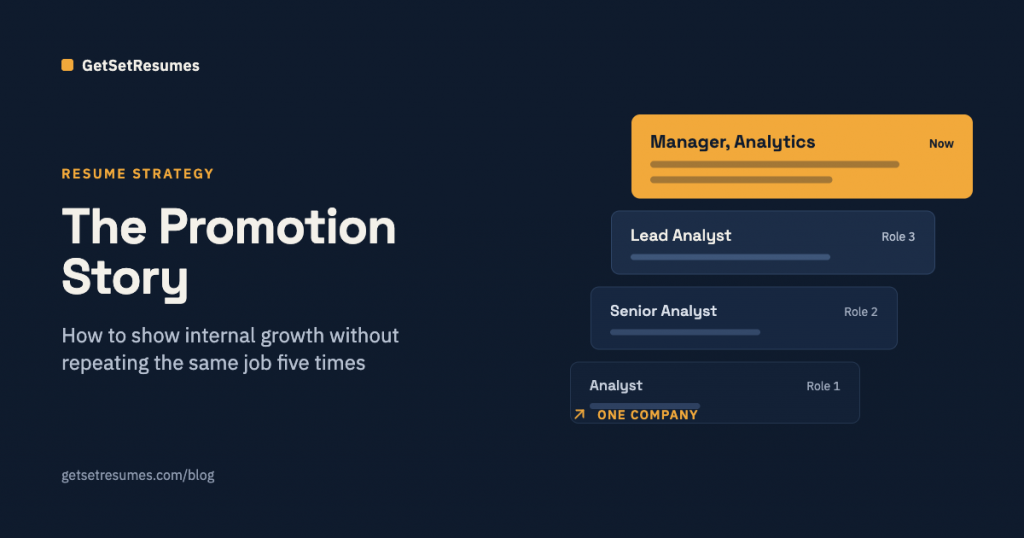
Getting promoted several times at the same company should be one of the strongest parts of your resume. It shows that your responsibilities grew, that your contributions were noticed, and that your organisation kept trusting you with more demanding work. To a hiring manager, that kind of progression can say more about you than a list of titles collected across five different employers.
Yet plenty of professionals struggle to put it across on paper.
Take someone who joined a company as a Business Analyst, became a Senior Business Analyst, moved into an Associate Manager role, and eventually became a Business Manager. Their resume lists all four designations under the same employer. But under every title, the bullets look almost the same: analysed business requirements, prepared reports, coordinated with stakeholders, supported process improvements. The titles suggest four stages of growth. The content suggests four versions of the same job.
That’s the promotion story problem. The goal isn’t just to show that you were promoted. It’s to show what changed because you were promoted.
This matters most when you’re preparing for your next move. A resume has to communicate not only where you’ve worked, but how your professional value has changed along the way. At Get Set Resumes, where we work often with experienced professionals and leadership candidates, that means turning a run of internal promotions into one coherent story of growing responsibility, wider influence, and measurable impact.
Why internal promotions are easy to misrepresent
When someone changes companies, their experience splits naturally into separate employers, roles, and achievements. Internal promotions are harder to present, because several designations often share the same organisational context, projects, stakeholders, and even day-to-day responsibilities. A Senior Manager may still sit in meetings they attended as a Manager. A newly promoted Director may keep overseeing a function they already ran. A Business Analyst who moves into management may still do technical analysis while picking up team leadership.
That overlap is normal. Career progression doesn’t mean dropping every earlier responsibility overnight. The trouble starts when the resume fails to separate what continued from what expanded, and that usually shows up in three ways.
The first is repeating responsibilities under every designation. A candidate describes stakeholder management, reporting, team coordination, and process improvement under three roles in a row, and even if the wording shifts slightly, the reader learns nothing new.
The second is giving every promotion the same amount of space. Someone who spent six years as an individual contributor and the next four leading a department shouldn’t necessarily give both stages equal room, since the more recent role usually offers stronger evidence of readiness for what comes next.
The third is listing promotions without explaining why they mattered. A move from Analyst to Manager to Senior Manager is useful information, but titles alone don’t show the scale of growth. Did the person start managing people, take ownership of a budget, lead a business unit, influence strategy, or become accountable for outcomes across several locations? Those shifts are what make a promotion story meaningful.
Start with the progression, not the job descriptions
Before rewriting any individual bullet, map how the role evolved. Here’s a typical example of a career with four internal steps.
ABC Technologies, 2017 to Present
Business Analyst, 2017 to 2019 Senior Business Analyst, 2019 to 2021 Associate Manager, 2021 to 2023 Business Manager, 2023 to Present
A conventional approach would start drafting a separate description for each position. A better one first identifies the defining shift at each stage.
| Career stage | What the role demonstrates |
| Business Analyst | Individual contribution and analytical execution |
| Senior Business Analyst | Greater project ownership and independent decision-making |
| Associate Manager | Team leadership, delivery oversight, and resource coordination |
| Business Manager | Functional accountability, business outcomes, and strategic planning |
These distinctions are illustrative, not automatic results of a promotion. The real responsibilities have to come from the candidate’s own experience. The point of the exercise is to understand the underlying progression before writing anything, because once that’s clear, each designation has a distinct job to do in the story and the content becomes much easier to organise.
How to structure multiple promotions under one company
For most professionals who’ve held several positions inside one organisation, a single employer heading is a practical starting point. It keeps the company name visible, makes the progression easy to scan, and avoids repeating company details. Here’s how that can look in practice.
Accenture, 2017 to Present
Business Manager, 2023 to Present
- Lead business planning and performance reviews across three functional teams, aligning operational priorities with quarterly business targets.
- Introduced a cross-functional reporting framework that reduced monthly reporting turnaround from eight days to five.
- Partner with senior leadership on resource allocation, delivery risks, and performance improvement initiatives.
Associate Manager, 2021 to 2023
- Supervised a team of eight analysts responsible for business reporting, requirements analysis, and process documentation.
- Standardised project tracking across four client accounts, improving delivery visibility and escalation management.
- Coordinated with technology and operations teams to resolve recurring workflow bottlenecks.
Senior Business Analyst, 2019 to 2021
- Owned requirements analysis and stakeholder coordination for a business process redesign project spanning two departments.
- Developed performance dashboards that improved visibility into project milestones and operational exceptions.
Business Analyst, 2017 to 2019
- Analysed business requirements, prepared functional documentation, and supported user acceptance testing for internal technology initiatives.
The metrics and achievements above are illustrative. A real resume should only include outcomes and figures that can be substantiated.
Look at how the descriptions change from one level to the next. The Business Analyst role establishes the analytical foundation. The Senior Business Analyst role shows ownership. The Associate Manager role introduces team leadership. The Business Manager role centres on functional performance and business decisions. The earlier experience stays visible without competing with the current position, and that’s how a resume communicates growth without pretending every promotion was a different career.
Writing different achievements for roles with overlapping responsibilities
This is usually the hardest part. Someone may have worked on the same client account, product, process, or business function for years, with responsibilities expanding gradually, so splitting achievements neatly by designation isn’t always easy. The way through is to separate three things: the activity, the level of ownership, and the outcome.
Picture a professional who spent eight years in sales at one company. Here’s what the resume might look like before any real thought goes into it.
Before: four titles, one repeated story
Sales Executive
- Managed client relationships and supported sales growth.
- Prepared sales reports and tracked performance.
- Coordinated with internal teams to meet targets.
Senior Sales Executive
- Managed client relationships and supported sales growth.
- Prepared sales reports and tracked performance.
- Coordinated with internal teams to meet targets.
Sales Manager
- Managed client relationships and supported sales growth.
- Prepared sales reports and tracked performance.
- Coordinated with internal teams to meet targets.
Regional Sales Manager
- Managed client relationships and supported sales growth.
- Prepared sales reports and tracked performance.
- Coordinated with internal teams to meet targets.
The wording isn’t the only issue. These descriptions never establish what made the person more senior at each stage. Now compare the same career written to show the progression.
After: four stages of increasing responsibility
Regional Sales Manager, 2022 to Present
- Lead regional sales planning and team performance across an assigned territory, overseeing pipeline reviews, key-account strategy, and target achievement.
- Developed a structured account-review process to improve opportunity visibility and prioritise high-value prospects.
Sales Manager, 2019 to 2022
- Managed a sales team responsible for new business development, account retention, and quarterly revenue targets.
- Introduced a sales pipeline review cadence to identify stalled opportunities and improve follow-up discipline.
Senior Sales Executive, 2016 to 2019
- Managed strategic customer relationships and negotiated commercial terms for high-value accounts.
- Supported account expansion through customer segmentation, renewal planning, and cross-selling opportunities.
Sales Executive, 2014 to 2016
- Built and maintained a client portfolio through prospecting, sales presentations, and ongoing customer engagement.
The story now moves from execution to account ownership, then team management, then regional leadership. The responsibilities may overlap in real life, but the emphasis shifts with the level of accountability.
One important caveat applies here. If a candidate has no distinct achievement to report for a particular role, the resume shouldn’t invent one. A short description of the role’s scope is far better than a made-up accomplishment or a repeated bullet in disguise.
What if your title changed but your work barely did?
Not every promotion brings an immediate, dramatic change in daily responsibilities. Sometimes the title changes before the scope really grows. Sometimes a company uses different titles for similar work. And sometimes a promotion simply recognises sustained performance rather than a new set of duties.
A resume should reflect what actually happened. If the promotion brought a real change in seniority, ownership, compensation responsibility, decision-making authority, or organisational influence, identify that change and describe it accurately. If the difference was mostly a title, don’t force a grand career narrative onto it. You can still present the promotion clearly and avoid duplicate bullets by grouping closely related responsibilities under one consolidated role entry, noting the progression of designations and dates, and giving more detail to the achievements that genuinely set your experience apart. The goal is credible progression, not a dramatic transformation invented for the page.
Should you combine all promotions into one entry?
Sometimes, but not always. The right structure depends on how different the roles were, how long you held each one, and how much evidence of progression the resume needs to carry.
Keep the roles separate when the promotions brought materially different responsibilities, when you moved from individual contribution into people management, when your scope grew from a local function to regional or global responsibility, when you took on budget ownership, P&L accountability, or strategic decision-making, or when each role holds distinct achievements that matter for the job you’re targeting.
Lean toward a more consolidated presentation when the designations changed but the responsibilities stayed largely the same, when earlier positions were short and added little evidence, when the resume is getting too long, or when you’ve held many internal titles and need to put recent, relevant experience first.
A technology professional who moved through three engineering titles but did broadly similar development work might use a compact entry for the earlier roles and describe their current engineering leadership position in more depth. Someone who went from Engineering Manager to Director of Engineering to VP of Engineering, with big changes in team size, product ownership, budget, and organisational influence, would usually benefit from clearer separation between those leadership stages. The rule is simple: separate roles when the distinction adds useful information, and consolidate them when it doesn’t.
Making promotions work for your next career move
A resume shouldn’t only document the career you’ve had. It should make a credible case for the one you want next. That matters especially for people leaving a long-term employer for a new organisation, since colleagues may understand their internal reputation and institutional knowledge, but an external recruiter can’t automatically interpret what each promotion meant. The resume has to supply that context.
- Moving from individual contributor to manager. Highlight delegation, mentoring, project ownership, team coordination, and responsibility for delivery. Technical expertise still counts, but the resume should show that your contribution reaches beyond your own output.
- Moving from manager to senior manager. Emphasise larger teams, multiple projects, cross-functional influence, resource planning, performance management, and improvements that extend past one immediate team.
- Moving from senior manager to director. Focus on departmental strategy, budgets, transformation initiatives, leadership of other managers, business performance, and alignment with organisational priorities.
- Targeting a VP or C-suite role. Prioritise enterprise-level impact, business growth, P&L responsibility where it applies, strategic decisions, risk management, major transformations, and influence across functions or markets.
These are positioning guidelines, not rigid promotion ladders. Titles and authority vary a lot between organisations, so the resume should communicate your actual scope instead of assuming a designation proves a certain level of leadership.
Five questions to audit your promotion story
Before you finalise a resume with several internal promotions, run it through these checks.
- Can a recruiter spot every promotion quickly? The employer, designations, and dates should make the progression easy to follow. Avoid formatting that makes several positions look like unrelated employers.
- Does each role add something new? Every entry should bring evidence of greater scope, stronger expertise, a different achievement, or useful career context. If two descriptions say the same thing, revise or consolidate them.
- Are achievements placed under the right roles? Dates and accomplishments should line up. A project finished in your current role shouldn’t be credited to an earlier designation just because it makes that earlier position look stronger.
- Does the current role get the right emphasis? Older roles set the foundation. Recent ones should usually provide the clearest evidence of current capability, especially if you’re aiming for a more senior position.
- Does the progression support the target job? A resume aimed at a leadership role shouldn’t spend disproportionate space on technical tasks that no longer define your value. Keep technical achievements where they show relevant expertise, but make sure the overall narrative fits the opportunity.
Your promotions should tell one career story
Internal growth is a valuable part of any career history, but it doesn’t speak for itself. Four promotions under one employer can signal sustained performance, increasing responsibility, and organisational trust. They can also produce a repetitive resume that leaves recruiters to work out the progression on their own. The difference lies in how the experience is presented.
Start by identifying what changed at each stage. Separate achievements from routine responsibilities. Give the most relevant positions the space they deserve. Compress earlier roles when they add little to the story. And make sure every designation has a clear reason to be on the page.
At Get Set Resumes, effective positioning means looking past job titles to understand a professional’s real contribution, career trajectory, and next-step ambitions. For experienced professionals, that can matter most when the strongest evidence of growth comes from years of progressing inside a single organisation.
Your resume shouldn’t make a recruiter read the same job five times. It should help them understand how you became qualified for the next one.